How AI Is Giving New Life To Legacy Systems

By Garrett Baird
VP, Product, Banking & Fintech, Paymentus
“Legacy” is an interesting word. For most people, it’s a positive—something left behind that is generally viewed as beneficial. In the world of billing and payments, “legacy” is mostly used as a pejorative. Legacy systems are often viewed as rigid, slow, and outdated.
But as I discussed with PYMNTS for their recent “When Legacy Becomes Leverage” What’s Next in Payments series, legacy systems can enjoy new life if complemented by strategic AI capabilities.
Why Legacy Systems Are Here To Stay
From an outside perspective, it’s easy to pass off legacy systems as liabilities. The fact is that for financial institutions in particular, around 75% of transactions are still running over mainframes due to their reliability and security. In short, these systems are stable and perform as expected—a critical requirement for an industry where trust and reliability are paramount.
There’s also the perceived cost and uncertainty that comes with modernization projects. Sticking with what you know is often the simplest answer, especially when there’s so much at stake. The challenge then becomes, how can service providers modernize in a way that preserves the stability they currently enjoy while offering customers the speed, personalization, and engagement they expect.
How a Lack of Orchestration Inhibits Legacy Performance
The ideal situation for service providers is to deploy systems that can easily adopt and accommodate new technologies as needed. Unfortunately, most systems are not designed for this kind of evolution. Instead, layers of middleware, APIs, and platforms are stacked on top of each other rather than seamlessly integrated.
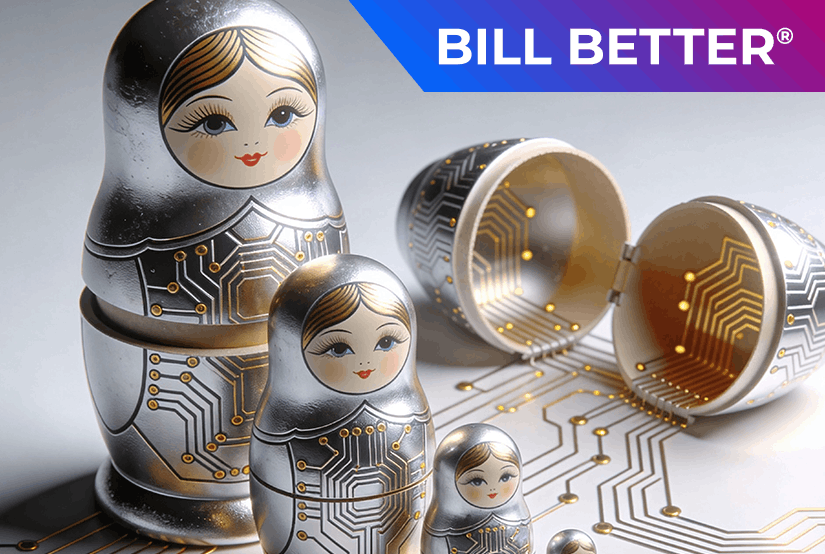
The first image that may come to mind is a giant knot, but one chief technology officer I spoke with compared it to a set of Russian nesting dolls. The difference is important. With Russian nesting dolls, one sits on top of another, completely blocking each from the next. This “connectivity” makes it so that to reach the fourth doll, you need to maneuver at least three others. This makes consumer-demanded concepts like personalization very difficult to deliver when traversing these layers at the near-real-time speed expected.
AI Solves the Orchestration Challenge
Sticking with the Russian nesting doll analogy, the job for service providers is to now go from a fragmented system to one that is orchestrated to work seamlessly across the entire platform. The options here are to rip and replace existing systems, which is far from ideal for many, or leverage new technologies that make orchestration possible. Enter AI.
AI may be thought of as an automation layer, but it’s also capable of becoming what I consider the connective tissue that can bring together fragmented and disparate systems. As I shared with PYMNTS, AI is uniquely good at finding the value and patterns within one’s relationship with a service provider. These are the invaluable insights that transform everyday interactions into relationship-building, Service Commerce experiences.
A key takeaway here is the AI-driven shift from infrastructure ownership to contextual intelligence. How this infrastructure is accessed and what can now be produced goes far beyond transactions and stability. Today, it is contextual intelligence that defines the experience, highlighted by faster, more personalized engagements—not simply transactions processed.
The Strategic Modernization Path for Service Providers
First and foremost, fragmentation must be eliminated for service providers to ensure the best possible outcomes. AI has the power to connect platforms, but ongoing additions must also fit within this dynamic or they risk undermining the experience they’re built to support.
Second, service providers must work with partners that offer solutions geared toward flexibility and connectivity. Tacking another layer onto your existing system places you right back at square one. It’s important to partner with a solution provider that seamlessly integrates with your organization’s current setup, while offering AI capabilities that help unlock the invaluable insights found within it.
View Garrett’s full interview with PYMNTS here. Interested in learning more about how Paymentus enables AI-driven orchestration to help you get more from your legacy system? Let’s talk! Our team of experts can share a demo and learn more about your specific goals and challenges.